How to Choose the Right Running Shoes (According to a Podiatrist)


How to Choose the Right Running Shoes (According to a Podiatrist)

Walk into any running shop and you’ll be met with a wall of shoes promising to be “the one”. But the pair that works wonders for your training buddy can be a fast track to shin splints for you — and that’s why finding the best running shoes is something a Perth podiatrist approaches very differently to a shop assistant.

My answer to “which shoe should I buy?” is never a brand name. It’s the pair that fits your feet and matches how you actually move — a decision behind a huge share of the niggles I see in clinic. Here’s how to choose without the guesswork.

Why Fit Matters More Than the Brand

Nobody ever got injured because their shoes were the wrong colour. Most running complaints — blisters, black toenails, sore arches, shin pain — come down to one thing: a shoe that doesn’t match the shape and movement of the foot inside it.

Every brand builds on a different “last” (the mould a shoe is shaped around). A shoe can be technically excellent and still be wrong for you because it’s too narrow in the toe, too firm in the heel, or cut too low across the arch. Get the fit right and the shoe disappears.

The thumb-width rule

The simplest check you can do at home: stand with your shoes laced and leave about a thumb’s width of space between your longest toe and the end of the shoe. Your feet swell as you run, and that room stops your toes jamming into the front on a long run.

Your feet change, so should your size

Feet aren’t a fixed size for life. They widen and flatten a little as we age, and pregnancy, weight changes and hours on your feet can all shift things. The size you wore five years ago isn’t necessarily your size today — one more reason online shoe shopping is a gamble.

Foot Type and Pronation: The Myth You’ve Been Sold

For years, runners were sorted into boxes — “overpronator”, “neutral”, “supinator” — and sold a matching shoe with a wedge of support built in. It sounded scientific, but the evidence never really backed it up.

What pronation actually is

Pronation is simply the natural inward roll of the foot as it lands. It isn’t a flaw; it’s your foot’s built-in shock absorber, and for most runners it causes no trouble.

What the research really says

A well-known 2014 study followed nearly a thousand novice runners and found that moderate foot pronation was not linked to a higher injury risk, even in a neutral shoe. In other words, strapping a motion-control shoe onto every “pronator” isn’t the injury-proofing move it was once sold as — comfort is a far more reliable guide than any label on a box.

Shoe Rotation: Give Your Shoes a Day Off

If you run most days, consider owning two pairs rather than grinding one into the ground. Rotating between two models spreads the load, lets the midsole foam recover between runs, and gently varies the forces on your feet and legs.

When to Replace Your Running Shoes

Running shoes don’t wear out the way you’d expect. The outsole can still look fine while the midsole — the part doing the actual shock-absorbing — has quietly gone flat. Once that cushioning dies, the impact you were avoiding travels up into your ankles, knees and hips.

Most podiatrists suggest replacing running shoes every 500 to 800 kilometres (roughly 300 to 500 miles), or every six months if you run regularly. Heavier runners may hit that limit sooner.

Signs it’s time

  • New aches are creeping in — sore knees, shins or arches — with no change in your training.
  • The midsole looks creased or compressed, even though the tread is still fine.
  • The shoe feels “flat” or dead compared with a newer pair.
  • The upper is worn through, or the heel no longer holds your foot snugly.

How a Perth Podiatrist Finds Your Best Running Shoes

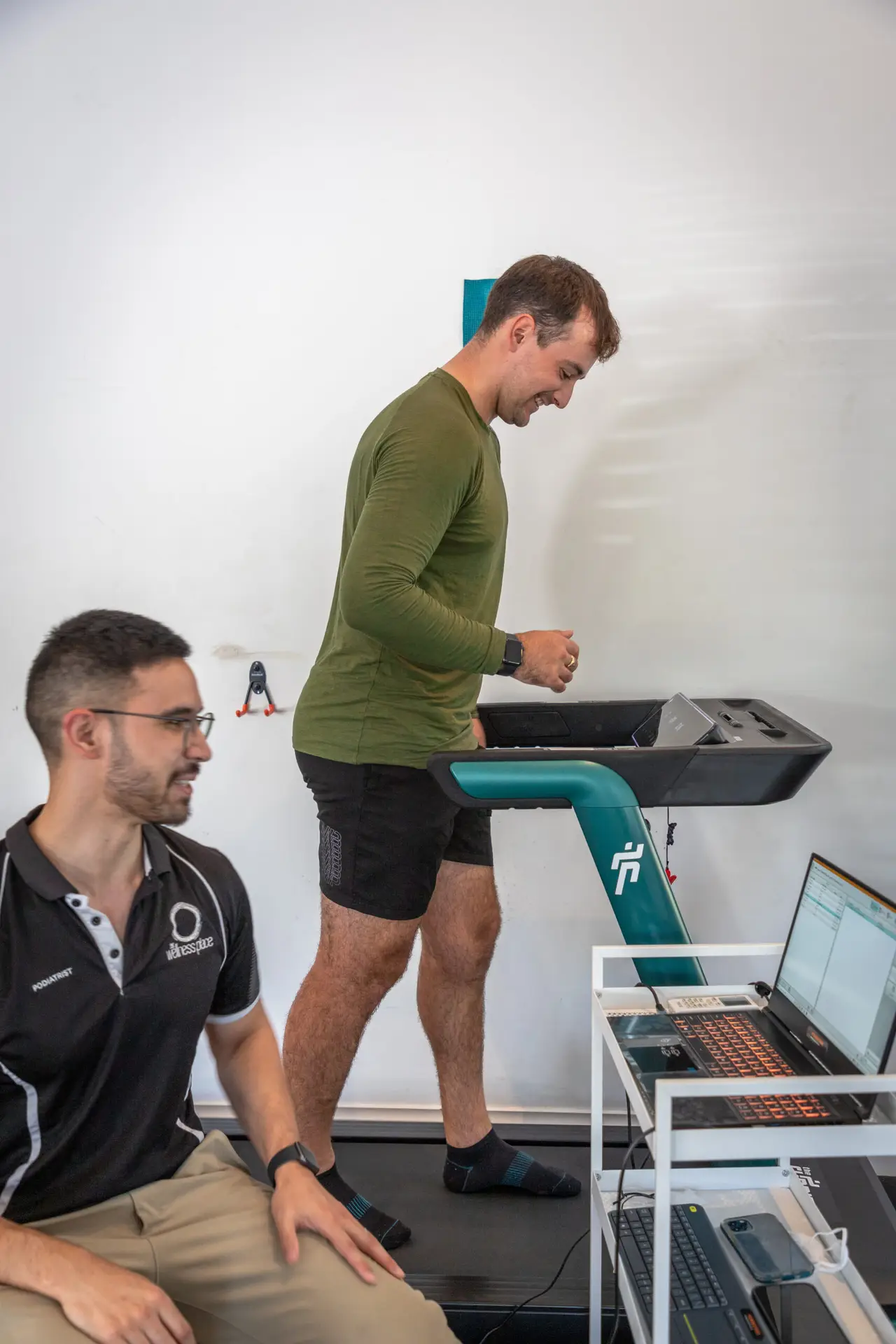
This is where a clinic visit genuinely beats a fitting in a busy store. Instead of eyeballing a worn tread pattern and guessing, a podiatrist measures how your feet actually move when you run.

At The Wellness Place in Bassendean, we use a Zebris pressure-plate gait analysis to see, in real time, exactly where pressure loads up under your feet — which part of your heel strikes first, how weight transfers across the midfoot, and whether you’re pushing off evenly. That data, combined with a proper assessment, means any shoe we recommend is based on your mechanics, not a best-seller list.

It’s particularly worthwhile if you’ve had repeated injuries, you’re returning to running after a break, or you’re training for an event. And if your feet need extra support, we can talk through whether custom orthotics are worth it — or whether the right shoe on its own does the job.

Five Common Running Shoe Mistakes

  • Buying the same model forever. Brands quietly update their lasts and cushioning, so today’s version of “your” shoe may fit differently.
  • Buying too small. If your toes touch the end, you’re inviting black toenails and blisters.
  • Replacing based on looks alone. Tread can outlast dead cushioning by months.
  • Racing in brand-new shoes. A fresh pair needs a few easy runs before any big effort.
  • Ignoring pain. A shoe should never hurt from day one. Discomfort that doesn’t settle is a sign the fit is off.

Ready to Find Your Perfect Fit?

The best running shoes in Perth aren’t the most expensive ones — they’re the pair that matches how you move. If you’re in or around Bassendean and tired of guessing, come and see us. Book a podiatry appointment and gait analysis at The Wellness Place, and we’ll help you find shoes that keep you running comfortably.

Call us on (08) 9379 3838 or visit us at 9 Old Perth Road, Bassendean.

References

  1. Nielsen, R. O., et al. (2014). “Foot pronation is not associated with increased injury risk in novice runners wearing a neutral shoe: a 1-year prospective cohort study.” British Journal of Sports Medicine. pubmed.ncbi.nlm.nih.gov/23766439
  2. Achilles Foot and Ankle Center. “When to Replace Running Shoes: Mileage, Wear Signs and Tips.” achillesfootandankle.com
  3. REI Co-op Expert Advice. “How Should Running Shoes Fit?” rei.com

Ankle Sprains: Why “Just Rest It” Isn’t Enough (and What Actually Works)


Ankle Sprains: Why “Just Rest It” Isn’t Enough (and What Actually Works)

You step off a curb, land awkwardly on the netball court, or catch your foot on the stairs — and that sharp, sickening twang shoots through your ankle. It’s swollen before you even get home, and every well-meaning mate tells you the same thing: “just rest it.”

Here’s the problem: resting alone is one of the most common reasons a simple rolled ankle turns into a weak, wobbly ankle that keeps rolling again and again. The right ankle sprain treatment Bassendean physios and podiatrists recommend looks very different — and in this guide we’ll walk through why rest isn’t enough, what to do in those first few days, and how to rebuild an ankle that actually holds up.

What Actually Happens When You Roll Your Ankle

Most ankle sprains are “lateral” sprains, which means the foot rolls inward and stretches — or tears — the ligaments on the outside of the ankle. The ligaments in the firing line are the anterior talofibular ligament (ATFL) and, in nastier rolls, the calcaneofibular ligament (CFL). It’s not broken bone causing your pain — it’s stretched connective tissue, which heals differently to bone.

The Three Grades of an Ankle Sprain

  • Grade 1 (mild): slight stretching with microscopic tearing. Mild swelling and tenderness, but you can usually still walk on it.
  • Grade 2 (moderate): a partial tear. Noticeable swelling, bruising, and pain when you bear weight.
  • Grade 3 (severe): a complete tear of the ligament. Significant swelling and bruising, and weight-bearing is genuinely difficult.

Here’s the point that surprises most people: even a Grade 1 sprain disrupts the ankle’s “position sense” — its ability to tell your brain where your foot is in space — which is why a “minor” sprain can still leave you feeling unsteady weeks later.

Why “Just Rest It” Backfires

Rest has its place in the first day or two, but prolonged rest is where the trouble starts. When you immobilise an ankle for too long, the muscles around it weaken, the ligament heals in a loose and disorganised way, and your balance system gets out of practice — leaving a joint that’s stiff, weak, and primed to roll again.

The statistics tell the story. Up to 40% of ankle sprains go on to develop ongoing symptoms — pain, swelling, and instability that persist for at least 12 months — and roughly one in five people develop what’s called chronic ankle instability. In plain English: if you don’t actively rehab an ankle sprain, it tends to become a recurring problem rather than a one-off.

The First Few Days: PEACE (Then a Little LOVE)

You might remember RICE — rest, ice, compression, elevation. Sports medicine has since moved toward a smarter framework called PEACE & LOVE, which fits what an injured ankle actually needs.

PEACE (immediately after injury)

  • P — Protect: ease off the ankle for the first one to three days, but don’t immobilise it entirely.
  • E — Elevate: prop the ankle above heart level where you can, to help fluid drain.
  • A — Avoid anti-inflammatories: inflammation is part of healing; ice and anti-inflammatory tablets may dull it short term but can slow tissue repair.
  • C — Compress: a bandage or brace reduces swelling without locking the joint up.
  • E — Educate: understand your injury — which is literally what you’re doing right now, and it genuinely improves outcomes.

LOVE (after the first few days)

  • L — Load: reintroduce movement and gentle weight-bearing as soon as pain allows.
  • O — Optimism: your headspace matters — people who expect to recover well tend to.
  • V — Vascularisation: pain-free cardiovascular exercise gets blood flowing to the healing tissue.
  • E — Exercise: the big one — a structured rehab program is what actually prevents re-injury.

The Part Most People Skip: Rehab and Return to Sport

Once the swelling settles, the real work begins. A good rehab program rebuilds three things in order: range of motion first, then strength, then balance and control. Skipping straight from “it stopped hurting” back to sport is the single most reliable way to roll it again.

Strength work for the calf and the small muscles around the ankle — plus balance drills like single-leg stands — retrains that position sense. This is also where a graded return-to-sport plan matters: hopping, cutting, and change-of-direction movements should be reintroduced progressively, not all at once in your first game back.

When to See a Podiatrist or Physio

You don’t need to tough it out alone. Book in if any of these sound familiar:

  • You can’t bear weight after a few days, or the pain is severe.
  • Swelling or bruising is significant or spreading.
  • You’ve sprained this ankle before, or it keeps giving way on you.
  • You want to get back to sport safely — and stay there.

Ankle Sprain Treatment Bassendean: How The Wellness Place Can Help

At The Wellness Place on Old Perth Road in Bassendean, our podiatrists and physiotherapists work together to get you back on your feet properly. Your podiatrist will assess the ankle, rule out anything more serious, and check how your foot mechanics may have contributed to the roll in the first place — sometimes a footwear or orthotics tweak is the missing piece. Our physiotherapy team then builds a hands-on rehab plan to restore strength, balance, and confidence.

Whether it’s your first ankle sprain or the one that keeps coming back, the goal is the same: an ankle that’s stronger and more stable than it was before you hurt it.

References

  1. Dubois B, Esculier JF. Soft-tissue injuries simply need PEACE and LOVE. British Journal of Sports Medicine. 2020;54(2):72–73.
  2. Vuurberg G, Hoorntje A, Wink LM, et al. Diagnosis, treatment and prevention of ankle sprains: update of an evidence-based clinical guideline. British Journal of Sports Medicine. 2018;52(15):956.
  3. Wagemans J, Bleakley C, Taeymans J, et al. Exercise-based rehabilitation reduces reinjury following acute lateral ankle sprain: a systematic review update with meta-analysis. PLoS ONE. 2022;17(2):e0262023.
  4. Recurrent Ankle Sprain. StatPearls [Internet]. Treasure Island (FL): StatPearls Publishing.

Rolled your ankle and want it assessed properly? Call The Wellness Place Bassendean on (08) 9379 3838 to book in with our podiatry or physiotherapy team. We’re at 9 Old Perth Road, Bassendean — and we’d much rather see you now than see you back here next season with the same ankle.